

Medications at Transitions and Clinical Handoffs (MATCH) Toolkit for Medication Reconciliation

Appendix: The MATCH Work Plan

Developing/Redesigning the Process

Many organizations are uncertain about how to proceed with designing a workable solution for medication reconciliation. This section provides helpful information and tools for designing or redesigning a medication reconciliation process.

 Building the Foundation for Your Medication Reconciliation Process Design

  • Process design—should center on the concept of a single list to document patient's current medications ("one source of truth").
  • Defining roles and responsibilities for medication reconciliation—determine which discipline(s) should be involved in each step of your medication reconciliation process, including their respective roles and responsibilities.
  • Integrating medication reconciliation into your existing workflow—prompts to complete required steps for medication reconciliation are essential.

Medication Reconciliation Upon Admission: High-Level Process Map BEFORE Redesign

  • Multiple, independent medication histories obtained from patient and documented throughout the medical record.
  • No prompts to cross-reference documentation, which may be conflicting.

Chart shows the following process: Patient Admitted to Hospital; Nurse obtains medication history and documents in the nursing admission patient assessment form. Physician obtains medication history and documents in admission note ('history and physical'). Changes or updates to history 'buried' in progress notes. Consult services and ancillary staff obtain medication histories as part of their initial assessment and document in discipline-specific forms/notes. Physician orders medications based on med list prior to admission and patient's current clinical status. (No standardized, consistent process for physicians to document and communicate ordering decisions for each home medication. Intended versus unintended discrepancies often unclear.) Nurse reviews medication orders prior to administration. Any discrepancies or issues identified are resolved with prescriber. (No standardized, consistent process for medication reconciliation. Increased time spent clarifying discrepancies due to inconsistent physician documentation, often creating double work for nurses and pharmacists.) Pharmacist reviews medication orders prior to verification and dispensing. Any discrepancies or issues identified are resolved with prescriber. Nurse administers medications to patient.

Medication Reconciliation Upon Admission: High-Level Process Map AFTER Redesign
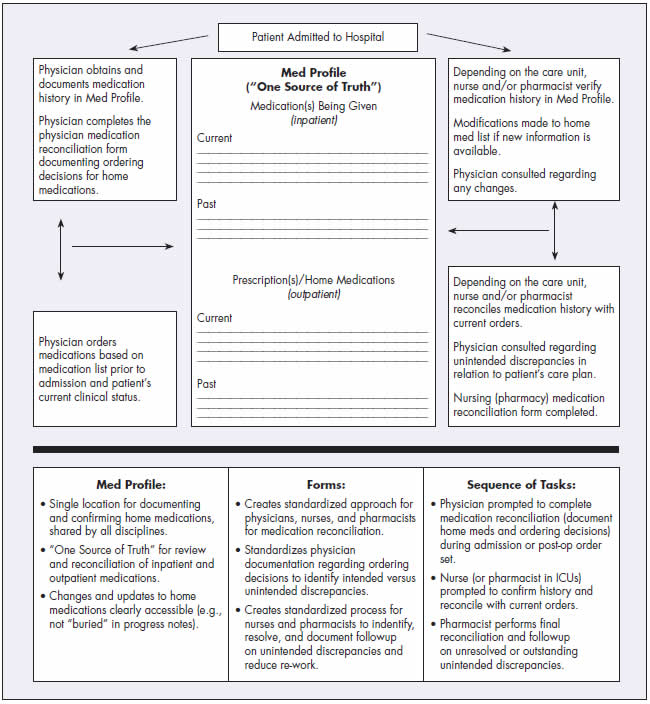
Chart shows the following process: Patient Admitted to Hospital. Physician obtains and documents medication history in Med Profile; Physician completes the physician medication reconciliation form documenting ordering decisions for home medications. Depending on the care unit, nurse and/or pharmacist verify medication history in Med Profile. Modifications made to home med list if new information is available. Physician consulted regarding any changes; Physician orders medications based on med list prior to admission and patient's current clinical status. Med Profile ('One Source of Truth') list - Medication(s) Being Given (inpatient) Current and Past; Prescription(s)/Home Medications (outpatient) Current and Past. Depending on the care unit, nurse and/or pharmacist reconciles medication history with current orders. Physician consulted regarding unintended discrepancies in relation to patient's care plan. Nursing (pharmacy) medication reconciliation form completed. Med Profile: Single location for documenting and confirming home medications, shared by all disciplines. 'One Source of Truth' for review and reconciliation of inpatient and outpatient medications. Changes and updates to home medications clearly accessible (e.g., not 'buried' in progress notes). Forms: Creates standardized approach for physicians, nurses, and pharmacists for medication reconciliation. Standardizes physician documentation regarding ordering decisions to identify intended versus unintended discrepancies. Creates standardized process for nurses and pharmacists to indentify, resolve, and document followup on unintended discrepancies and reduce re-work. Sequence of Tasks: Physician prompted to complete medication reconciliation (document home meds and ordering decisions) during admission or post-op order set. Nurse (or pharmacist in ICUs) prompted to confirm history and reconcile with current orders. Pharmacist performs final reconciliation and followup on unresolved or outstanding unintended discrepancies.

Medication Reconciliation Upon Discharge: High Level Process Map AFTER Redesign

Chart shows the following process: Patient Being Discharged From Hospital. Physician places medication reconciliation order and reviews hospital orders and pre-admission medication list; Physician updates prescription/home medications to reflect new discharge medication list. Physician pulls updated home medication list into discharge instructions (for patient) and discharge summary (for next provider of care), highlighting changes. Med Profile ('One Source of Truth') list - Medication(s) Being Given (inpatient) Current and Past; Prescription(s)/Home Medications (outpatient) Current and Past. Nurse completes nursing discharge note and is prompted to confirm patient is being discharged with an updated home medication list from the physician. Patient is counseled. Physician is consulted for resolution of discrepancies and questions. Med Profile: Single location to review and update home medications at time of discharge. 'One Source of Truth' for review and reconciliation of inpatient and outpatient medications. Changes and updates to home medications clearly accessible. Prescription/home medication information remains stored in the current folder and is available for review and modifications for future admissions. Forms: Standardizes physician review and documentation of home medications in preparation for discharge. Template provides reminders and section for physician to highlight changes to prior medications and document new prescription information. Creates standardized process for nurses to indentify, resolve, and document followup on unintended discrepancies at discharge. Sequence of Tasks: Physician places medication reconciliation order, performs reconciliation, and updates home medication list in preparation for discharge. Nurse prompted to confirm history patient receives an updated medication list upon completion of nursing discharge form.

[Insert your Organization's Logo Here]Patient Name:
MR#:
Date:
Fin #:

Your Current Medication List (Name___________________________________________________
____________________________________________________________________________________ )

Please complete the following information. A registered nurse will review this list and update it, if needed, when you arrive for your surgery, procedure, or test.

ALLERGIES: None _____ (please check none) or list:

Source of AllergyReactionSource of AllergyReaction
Example: PenicillinHives3. 
1. 4. 
2. 5. 
Medication List the names of any medications you are taking. Please include any over the counter medicines (including vitamins, minerals, and herbal supplements). Also include any medications you held for your procedure.Strength List the strength of each tablet, capsule, etc.Dose How much are you taking? (number of tablets, capsules, units, etc.)Frequency How often do you take the medication? (daily, twice a day, monthly, etc.)Route How are you taking this medication? (by mouth, injection, patch, etc.)Last Dose Taken Indicate the date and time of the last dose taken
Example: Toprol XL100 mg1 Tabletevery dayby mouththis morning


Return to Appendix Contents
Proceed to Next Section

Current as of December 2012
Internet Citation: Medications at Transitions and Clinical Handoffs (MATCH) Toolkit for Medication Reconciliation: Appendix: The MATCH Work Plan. December 2012. Agency for Healthcare Research and Quality, Rockville, MD. http://www.ahrq.gov/professionals/quality-patient-safety/patient-safety-resources/resources/match/matchap6.html