





The Improvement Cycle: Plan-Do-Study-Act
A basic underlying principle of quality improvement (QI) is that it is a continuous activity, not a one-time thing. QI is an iterative process in which you will be making changes, followed by corrections along the way, as you learn from each step of the QI experience and identify actions to enhance your initial strategy of change. As you implement changes, there will be issues to address and challenges to manage; things are never perfect. You can learn from your experiences and then use those lessons to shift strategy and incorporate additional interventions, as needed, so you continue to move incrementally toward your improvement goals.
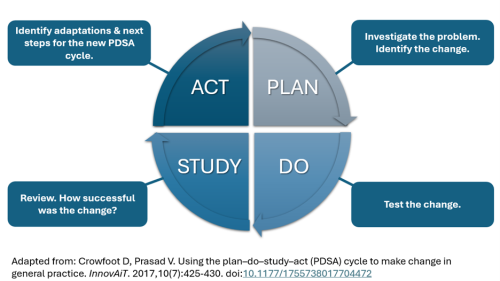
The fundamental approach that serves as the basis for most process improvement and QI models is known as the PDSA cycle, which stands for Plan-Do-Study-Act (Figure 1). This cycle is a systematic series of steps for gaining valuable experience and knowledge for the continual improvement of a product or process.
Figure 1. Plan-Do-Study-Act (PDSA) Cycle
The cycle has four main parts:
- Plan. This step involves creating a team, investigating the problem, identifying an improvement goal, formulating an intervention or theory for change, defining metrics of success, and drafting a plan of action.
- Do. This step involves implementing the components of the plan to test the change.
- Study. This step involves reviewing and monitoring the selected metrics, assessing how well the plan works, and identifying problems and potential solutions. Short-cycle, small-scale tests, coupled with analysis of test results, are helpful because they enable teams to learn from these tests before they implement actions more broadly.1,2,3
- Act. This step at the end of the cycle involves integrating the lessons learned throughout the entire process to adjust the goal, change the methods, or even reformulate an intervention or improvement initiative altogether. It is a synthesis phase in which your team identifies adaptations and next steps.
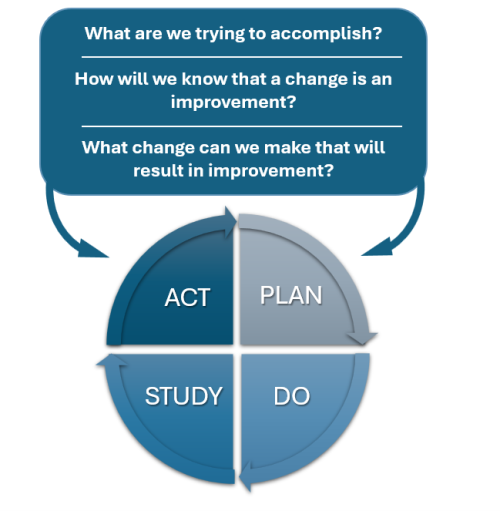
Start With Three Key Questions
The Institute for Healthcare Improvement’s (IHI) Model for Improvement recommends using three fundamental questions to guide the PDSA process:
Learn more about IHI’s Model for Improvement.
The PDSA cycle is led by a small team but involves all staff in assessing problems and suggesting and testing potential solutions. Insights and input from other stakeholders, such as patients and families, contribute to better understanding of the problem and identifying solutions as well. This bottom-up approach increases the likelihood that staff will embrace the changes, a key requirement for successful QI.4,5
 Related topic brief: Applying the PDSA Cycle to Improving Patient Experience.
 Visit the Resource Library to review key articles on implementing and sustaining innovations in healthcare settings.
1. Berwick DM. Developing and testing changes in the delivery of care. Ann Intern Med 1998;128(8):651-6.
2. Iles V, Sutherland K. Organizational change: a review for health care managers, professionals and researchers. London: NCCSDO; 2001.
3. Hempel S, Bolshakova M, Turner, BJ, et al. Evidence-based quality improvement: a scoping review of the literature. J Gen Intern Med 2022,37:4257–4267. https://doi.org/10.1007/s11606-022-07602-5.
4. Greenhalgh T, Robert G, Bate P, et al. How to spread good ideas: a systematic review of the literature on diffusion, dissemination and sustainability of innovations in health service delivery and organization. London: NCCSDO; 2004.
5. Greenhalgh T, Robert G, Macfarlane F, Bate P, Kyriakidou O. Diffusion of innovations in service organizations: systematic review and recommendations. Milbank Q 2004;82(4):581-629. doi: 10.1111/j.0887-378X.2004.00325.x. PMID: 15595944; PMCID: PMC2690184.

